
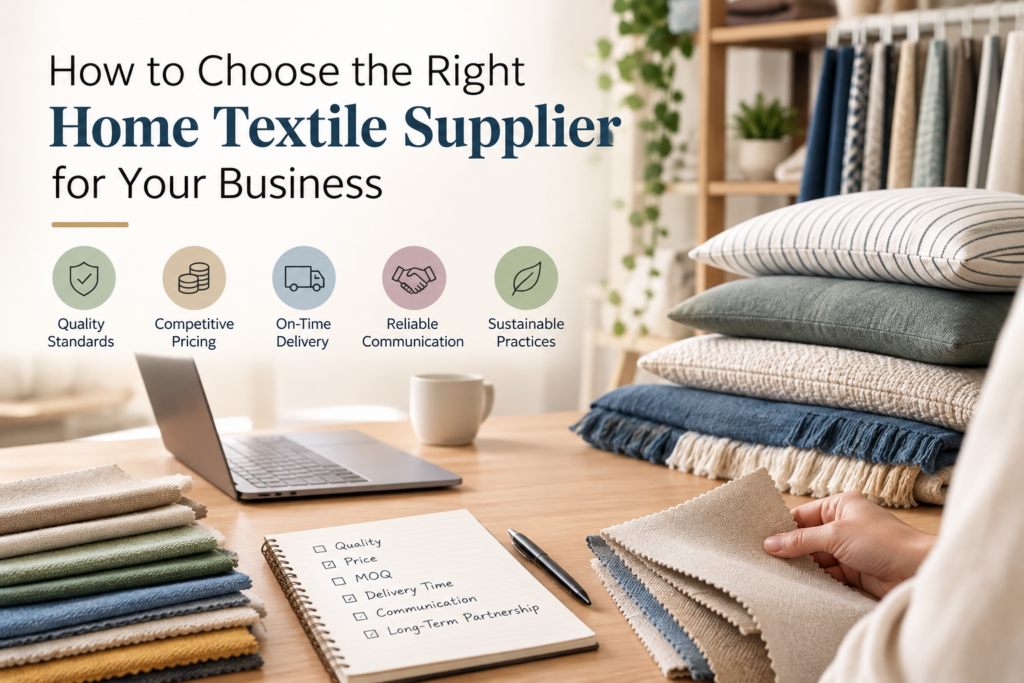
Choosing the right home textile supplier is one of the most important decisions for retailers, wholesalers, importers, and home décor brands. A supplier does much more than provide products. Their quality, communication, pricing, production capacity, and delivery reliability can directly affect your business.
A supplier offering a low price may look attractive at first, but if the quality is inconsistent or orders are regularly delayed, the lower price may end up costing your business more.
On the other hand, a reliable supplier can help you maintain consistent product quality, develop new products, manage repeat orders, and build a stronger relationship with your customers.
If you are sourcing home textiles from India or another country, it is important to look beyond the product catalog and carefully evaluate the supplier before starting a long-term business relationship.
Here are the key factors to consider when choosing the right home textile supplier.
1. Understand What You Need Before Looking for a Supplier
Before contacting suppliers, clearly define what you want to buy.
Your requirements may include:
- Bed linen
- Cushion covers
- Curtains
- Table linen
- Kitchen textiles
- Throws
- Blankets
- Other home furnishing products
You should also have an idea about the materials, sizes, colors, designs, and quantities you need.
For example, instead of simply asking for “cotton cushion covers,” you may specify the fabric type, size, color, design, stitching, closure, label, and packaging.
The clearer your requirements are, the easier it will be for suppliers to provide accurate information and pricing.
2. Look for Experience in Your Product Category

Not every textile supplier has the same experience.
Some manufacturers may specialize in bed linen, while others may focus more on cushion covers, table linen, curtains, or other home furnishing products.
When evaluating a supplier, look at their experience with the products you actually want to source.
An experienced supplier is more likely to understand important details such as fabric selection, stitching, finishing, measurements, packaging, and production requirements.
You can also ask about their existing product range and manufacturing capabilities.
3. Check Product Quality Carefully
Quality should be one of your biggest priorities.
A product may look attractive in photographs but feel very different when you see the actual item.
Before placing a large order, carefully review samples.
Check:
- Fabric quality
- Fabric feel
- Stitching
- Measurements
- Color
- Print quality
- Finishing
- Overall appearance
Pay attention to small details. Loose threads, uneven stitching, poor finishing, or incorrect measurements can create problems when products reach your customers.
A good supplier should be able to maintain the agreed quality throughout the production process, not just provide one good sample.
4. Always Ask for Samples
Samples are one of the most useful tools for evaluating a supplier.
Never depend entirely on photographs or product descriptions when making an important sourcing decision.
A physical sample allows you to see and feel the product yourself.
For customized products, ask the supplier to develop a sample according to your specifications.
For example, if your brand requires a particular shade of beige, a specific fabric, and a custom size, the sample should reflect those requirements.
Once you are satisfied with the sample, clearly communicate that it is the approved reference for bulk production.
This can help reduce misunderstandings later.
5. Compare Quality and Price Together
Price is naturally an important part of sourcing, but choosing the cheapest supplier is not always the best decision.
Imagine two suppliers quote different prices for the same cushion cover.
Supplier A offers a lower price but uses a lighter fabric and basic finishing.
Supplier B costs slightly more but offers better fabric, stronger stitching, and better packaging.
The second supplier may actually provide better value for your business.
When comparing quotations, make sure you are comparing products with similar specifications.
Consider:
- Fabric
- Size
- Construction
- Finishing
- Packaging
- Quantity
- Customization
A clear comparison can help you understand what you are actually paying for.
6. Check Their Minimum Order Quantities
Different suppliers have different minimum order requirements.
Before finalizing a supplier, ask about their minimum order quantity, commonly called MOQ.
You may need to know:
- Minimum quantity per product
- Minimum quantity per color
- Minimum quantity for custom designs
- Minimum quantity for private-label products
- Minimum quantity for custom packaging
This is especially important for smaller or newer brands.
For example, if you want to test a new cushion cover collection, ordering thousands of pieces immediately may not be practical.
Understanding the supplier’s MOQ can help you plan your product range and inventory more effectively.
7. Evaluate Their Customization Options
If you are building your own brand, customization can be very important.
Depending on the supplier, you may be able to customize:
- Fabric
- Colors
- Prints
- Sizes
- Labels
- Packaging
- Product designs
For example, a home décor brand may want its own collection of cushion covers with custom colors and branded labels.
A supplier with experience in customized production can make this process much easier.
Before starting, ask about customization costs, minimum quantities, development time, and sample approval.
Clear communication at this stage can prevent problems during production.
8. Ask About Quality Control
A professional supplier should have a quality control process.
Ask how they check products before they are shipped.
Important questions include:
- Are products inspected during production?
- Is there a final inspection?
- Are measurements checked?
- Are colors and prints checked?
- How are defective products handled?
- Is packaging inspected?
Quality control is particularly important for international orders because returning or replacing defective products can be expensive and time-consuming.
A supplier that takes quality checks seriously is more likely to provide consistent products.
9. Check Their Production Capacity
Your supplier should be able to handle your current order and ideally support your future growth.
Ask about their production capabilities and typical production timelines.
For example, if you currently need 2,000 pieces but expect your business to grow to 10,000 pieces per order, it is useful to know whether the supplier can handle larger quantities in the future.
At the same time, the biggest manufacturer is not automatically the best option.
The right supplier is one whose production capacity matches your business requirements.
10. Pay Attention to Communication
Communication is extremely important when working with an international supplier.
You may be dealing with different time zones, languages, measurements, currencies, and shipping requirements.
A good supplier should communicate clearly about:
- Product specifications
- Prices
- Samples
- Production
- Packaging
- Shipping
- Delivery timelines
Pay attention to how they respond to your questions.
Do they understand your requirements? Do they provide clear answers? Do they tell you when something is not possible?
Honest communication is usually better than a supplier who simply says yes to everything.
11. Check Their Packaging Capabilities
Packaging is another important part of international sourcing.
Home textile products need suitable packaging to protect them during storage and transportation.
Depending on your requirements, packaging may include:
- Brand labels
- Care labels
- Product tags
- Poly bags
- Boxes
- Custom packaging
- Product cards
If you are selling products under your own brand, discuss your packaging requirements before production begins.
The packaging should protect the product and also provide a good presentation when it reaches your customer.
12. Discuss Production and Delivery Timelines
A supplier can produce excellent products, but delays can still create problems for your business.
Before placing an order, discuss the expected timeline for:
- Sample development
- Sample approval
- Material sourcing
- Bulk production
- Quality inspection
- Packaging
- Shipment preparation
Do not rely on vague promises such as “we will deliver very soon.”
Ask for a realistic timeline based on your actual order quantity and specifications.
This is particularly important if you are sourcing seasonal products.
For example, if you need Christmas or winter products for a particular sales season, late delivery could mean missing an important part of your selling period.
13. Think About Long-Term Reliability
Finding a supplier should not only be about your first order.
Think about whether you can work with the company for the next several years.
A good long-term supplier should be able to provide:
- Consistent quality
- Reliable communication
- Reasonable production timelines
- Product development support
- Repeat-order consistency
Once a supplier understands your product specifications and quality expectations, future orders can become easier to manage.
A strong supplier relationship can also make it easier to introduce new products and collections.
Questions to Ask a Home Textile Supplier
Before choosing a supplier, consider asking these questions:
What home textile products do you manufacture?
What fabrics and materials do you offer?
Can you provide samples?
What is your minimum order quantity?
Can you manufacture customized products?
Can you provide private-label products?
What quality control process do you follow?
What is your typical production time?
What packaging options do you provide?
Do you have experience with international buyers?
Getting clear answers to these questions can help you compare suppliers more effectively.
Common Mistakes to Avoid When Choosing a Supplier
Choosing Only on Price
The cheapest quotation does not always offer the best value.
Skipping the Sample
A sample gives you the opportunity to check the actual product before committing to a large order.
Giving Unclear Specifications
Clear product details reduce misunderstandings.
Ignoring Production Capacity
Make sure the supplier can handle your current and future requirements.
Not Discussing Packaging
Packaging requirements should be discussed before production starts.
Trusting Promises Without Verification
Ask questions, review samples, and evaluate the supplier’s actual capabilities.
Final Checklist
Before selecting your home textile supplier, make sure you have checked:
✓ Product experience
✓ Fabric quality
✓ Samples
✓ Stitching and finishing
✓ Quality control
✓ Pricing
✓ Minimum order quantity
✓ Customization options
✓ Production capacity
✓ Communication
✓ Packaging
✓ Delivery timelines
✓ Long-term reliability
Taking the time to evaluate these factors can help you avoid many common sourcing problems.
Conclusion
Choosing the right home textile supplier is an important step for any retailer, wholesaler, importer, or home décor brand.
The right supplier should offer more than competitive pricing. They should understand your products, maintain consistent quality, communicate clearly, meet realistic production timelines, and support your business as it grows.
Before placing a large order, request samples, check product quality, discuss your specifications, understand the supplier’s capabilities, and make sure all important details are clear.
A reliable supplier can become much more than a company that produces your products. They can become a long-term manufacturing partner who helps you develop better collections and serve your customers more effectively.
Looking for a reliable home textile supplier in India? Abhishek Exports works with international buyers to supply home furnishing and textile products according to their product, quality, and customization requirements. Contact us to discuss your sourcing requirements.