
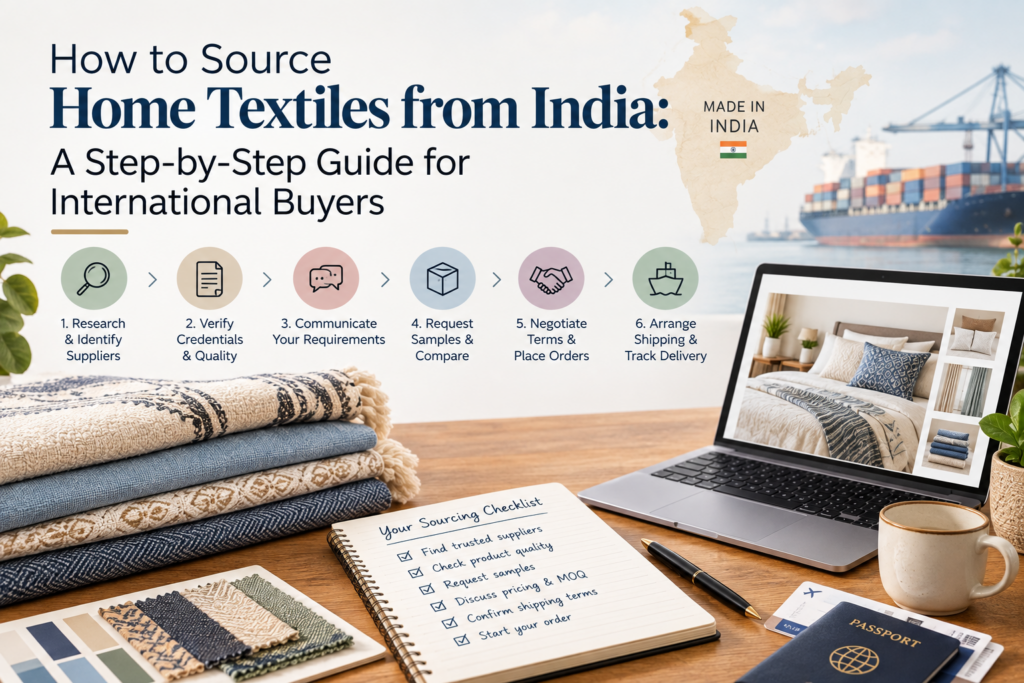
India has a long history of textile production and is known for its wide range of fabrics, traditional craftsmanship, and modern textile manufacturing. For international retailers, wholesalers, importers, and home décor brands, India can be an attractive sourcing destination for home furnishing products.
However, sourcing from another country requires proper planning. Finding a supplier is only the first step. Buyers also need to understand product requirements, samples, pricing, quality, packaging, shipping, and communication before placing an order.
Whether you are sourcing bed linen, cushion covers, curtains, table linen, kitchen textiles, throws, or other home furnishing products, having a clear sourcing process can make the experience much easier.
In this guide, we will explain the basic steps international buyers can follow when sourcing home textiles from India.
1. Decide What Home Textile Products You Need
The first step is to clearly define your product requirements.
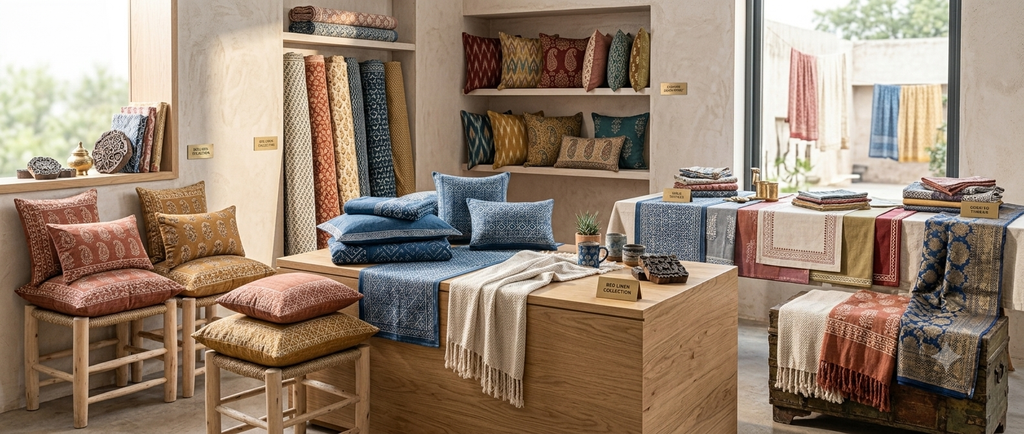
India has manufacturers and exporters producing many different types of home textile products, including:
- Bed sheets
- Duvet covers
- Pillow covers
- Cushion covers
- Curtains
- Tablecloths
- Table runners
- Kitchen towels
- Throws
- Blankets
- Other home furnishing products
Before contacting suppliers, make a basic list of the products you are interested in.
You should also think about the quantity you may need, your target price range, and the type of customers you want to sell to.
For example, a premium home décor brand may be looking for linen cushion covers with custom labels, while a large retailer may need thousands of cotton bed sheets at a competitive price.
Having clear requirements makes it easier for suppliers to understand your expectations.
2. Choose the Right Type of Supplier
When sourcing from India, you may come across manufacturers, exporters, wholesalers, and trading companies.
These businesses can have different capabilities.
If you require customized products or large quantities, working directly with a manufacturer or an experienced exporter may be more suitable.
Look for a supplier that has experience with the products you need.
For example, if your main requirement is home furnishing textiles, a supplier specializing in home textiles may be more useful than a company that mainly produces apparel fabrics.
Ask potential suppliers about:
- Their main product categories
- Manufacturing capabilities
- Experience with international buyers
- Customization options
- Production capacity
- Export experience
The right supplier should match your requirements rather than simply offering the largest product catalog.
3. Check the Supplier Before Placing an Order
It is important to do some basic research before starting a business relationship with a new supplier.
Look at their website, product range, company information, and communication.
You can also ask questions about their manufacturing process and experience with international customers.
A professional supplier should be able to provide clear information about their products and business.
Be careful if a supplier avoids basic questions, provides unclear product information, or makes unrealistic promises about pricing or delivery.
You do not need to make the decision in a hurry. Take enough time to compare different suppliers before choosing one.
4. Share Clear Product Specifications
Once you have shortlisted a supplier, provide clear product details.
This is one of the most important parts of international sourcing.
Your specifications may include:
- Product type
- Fabric
- Fabric weight
- Size
- Color
- Design
- Pattern
- Stitching
- Finishing
- Labels
- Packaging
- Quantity
If you have photographs, drawings, product samples, or technical specifications, share them with the supplier.
For example, instead of saying:
“I need cotton cushion covers.”
You can provide details such as:
“I need 100% cotton cushion covers in 45 x 45 cm size, with a particular color, zipper closure, branded label, and individual packaging.”
Clear instructions reduce the chances of misunderstanding.
5. Request Samples
Before placing a large order, ask for samples.
This gives you an opportunity to evaluate the actual product instead of relying only on photographs.
When you receive the sample, check:
- Fabric quality
- Feel and texture
- Color
- Size
- Stitching
- Print quality
- Finishing
- Labels
- Packaging
If you require a customized product, ask the supplier to make the sample according to your specifications.
For example, if you are developing a private-label bedding collection, the sample should include the correct fabric, measurements, design, labels, and other important details.
Once you approve the sample, make sure the final production follows the agreed specifications.
6. Compare Prices Properly
When comparing Indian home textile suppliers, do not look at the price alone.
Two suppliers may offer very different prices because their products have different specifications.
One supplier may use a heavier fabric, better finishing, stronger stitching, or more detailed packaging.
When comparing quotations, make sure you are comparing similar products.
Consider:
- Fabric
- Size
- Construction
- Finishing
- Quantity
- Labels
- Packaging
- Customization
A slightly higher product price may provide better value if the quality is also better.
The goal should be to find the right balance between quality, price, and your target market.
7. Understand Minimum Order Quantities
Minimum order quantity, or MOQ, is another important point to discuss with your supplier.
The MOQ may depend on:
- Product type
- Fabric
- Color
- Design
- Customization
- Labels
- Packaging
For example, a standard product may have a lower MOQ than a completely customized product.
If you are a new brand, ask about the minimum quantity before finalizing your collection.
This can help you avoid ordering more products than your business can reasonably sell.
At the same time, larger orders may sometimes provide better pricing, so it is useful to discuss different quantity levels with the supplier.
8. Discuss Customization and Private Label Requirements
Many international brands want products that are unique to their business.
Indian home textile manufacturers can produce customized products depending on their capabilities.
Customization may include:
- Custom colors
- Custom prints
- Custom sizes
- Embroidery
- Brand labels
- Care labels
- Custom packaging
If you are building a private-label brand, discuss these requirements at the beginning.
Do not wait until production has started to ask about custom labels or packaging.
Discuss everything in advance, including additional costs, minimum quantities, sample requirements, and production time.
9. Understand Quality Control
Quality control is particularly important when importing products from another country.
Before placing your order, ask the supplier how they check product quality.
A quality control process may include checking:
- Fabric
- Measurements
- Stitching
- Colors
- Prints
- Finishing
- Labels
- Packaging
You should also discuss what happens if products do not meet the agreed specifications.
For larger orders, some buyers may choose to arrange an independent inspection before shipment.
The most important point is to make sure both buyer and supplier have a clear understanding of the expected quality before production begins.
10. Discuss Packaging for International Shipping
Home textile products need suitable packaging when they are being transported internationally.
The packaging should protect the products from dust, moisture, damage, and other issues during transportation.
Depending on your requirements, you may need:
- Individual product packaging
- Brand labels
- Product tags
- Care labels
- Cartons
- Custom packaging
Ask the supplier how the products will be packed for export.
If you are selling directly to consumers, you should also consider how the packaging will look when the customer receives the product.
Good packaging can protect the product while also creating a better presentation.
11. Understand Shipping and Delivery Timelines
Before placing an order, discuss the complete production and shipping timeline.
This may include:
- Sample development
- Sample approval
- Material sourcing
- Production
- Quality inspection
- Packaging
- Shipment preparation
- International transportation
Ask the supplier for a realistic production timeline.
You should also discuss the shipping terms and understand which costs are included in the quotation.
If you are ordering seasonal products, plan well in advance.
For example, if you need Christmas home décor products, waiting until the last moment to place your order could create unnecessary pressure.
12. Communicate Regularly During Production
Good communication can make international sourcing much easier.
Once production begins, stay in contact with your supplier and ask for updates when necessary.
Important updates may include:
- Production progress
- Material availability
- Sample approvals
- Quality issues
- Packaging
- Expected completion date
If there is a problem, it is usually better to discuss it early rather than after the order has already been completed.
Clear communication also helps both sides understand changes to the order.
Common Mistakes International Buyers Should Avoid
Choosing a Supplier Only Because of a Low Price
A low price may not mean good value if the quality is poor.
Placing a Large Order Without Checking Samples
Always review samples before committing to a large production order.
Giving Incomplete Product Details
Clear specifications help avoid mistakes.
Ignoring Packaging
Poor packaging can damage products during international transportation.
Not Discussing Timelines
Make sure you understand how long production and shipment are expected to take.
Changing Requirements at the Last Moment
Frequent changes can affect production time and cost. Try to finalize important details before production begins.
Why India Can Be an Interesting Sourcing Market for Home Textiles
India offers a wide variety of textile materials, products, designs, and manufacturing capabilities.
For international buyers, this can provide flexibility when developing different types of home furnishing collections.
Buyers can source products for different market segments, from everyday home textiles to more premium and customized collections.
India’s textile industry also combines traditional textile skills with modern manufacturing, allowing buyers to explore both classic and contemporary product styles.
However, as with sourcing from any country, the quality and capabilities of individual suppliers can vary.
This is why careful supplier selection is still important.
A Simple Checklist for Sourcing Home Textiles From India
Before placing your first order, make sure you have checked:
✓ Product specifications
✓ Fabric quality
✓ Supplier experience
✓ Product samples
✓ Pricing
✓ Minimum order quantity
✓ Customization options
✓ Quality control
✓ Packaging
✓ Production timeline
✓ Shipping arrangements
✓ Communication
Taking care of these points can make the sourcing process more organized and reduce the risk of unexpected problems.
Conclusion
Sourcing home textiles from India can be a good opportunity for international retailers, wholesalers, importers, and home décor brands.
However, successful sourcing requires more than finding a supplier with attractive prices.
Start by clearly defining your products and requirements. Then research suppliers, compare their capabilities, request samples, check quality, discuss customization, understand MOQs, and agree on packaging and delivery expectations.
Most importantly, look for a supplier that communicates clearly and can consistently meet your requirements.
A reliable sourcing relationship can make future orders easier and help your business develop better home textile collections over time.
Looking to source home furnishing and textile products from India? Abhishek Exports works with international buyers to supply home textile products according to their product, quality, design, and customization requirements. Contact us to discuss your sourcing requirements.